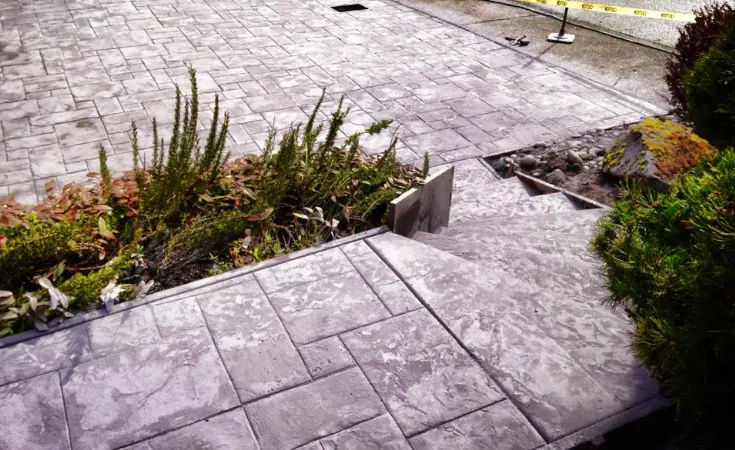
Concrete Resurfacing for Seattle Driveways, Patios & Steps
Exterior concrete resurfacing bonds a new wearing surface to an existing slab, so a driveway, patio, walkway, set of steps, or pool deck that is scaled, stained, or simply tired can look new again without a tear-out. Seattle Concrete provides exterior resurfacing across King, Snohomish, Pierce, and Thurston counties. It only works on concrete that is structurally sound, and in Seattle’s wet climate it only lasts with thorough surface prep and a good sealer. This page covers the overlay types, when resurfacing fails, and how it compares with replacement on cost.
Free on-site estimate · Call (206) 552-9998 or request a quote
Resurfacing a garage, basement, or other interior floor instead? See concrete floor resurfacing.
Surfaces we resurface
- Driveways: a broom-finish or decorative overlay restores traction and a uniform color. Vehicle traffic wears overlays faster than foot traffic, so driveway overlays need a durable product and regular resealing.
- Patios: the most common resurfacing job, often with a stamped or stained overlay that changes the look completely. Patio resurfacing pairs well with crack repair and slab lifting; see concrete patio installation and repair for the full range of patio work.
- Steps and stoops: thin overlays restore worn treads and chipped nosings. Keeping the added thickness even matters, because building up only the top tread changes the height of the top and bottom steps and creates a trip hazard.
- Walkways and entries: a fresh surface on a front walk is one of the quickest curb-appeal fixes when the concrete underneath is still sound.
- Pool decks: spray-down (knockdown) textures are a common choice because the texture grips well under wet feet.
Overlay types for exterior concrete
Broom or trowel-down overlays are a polymer-modified cement layer, roughly 1/8–1/4 inch thick, spread over the prepared slab and finished with a broom for grip. They are the most affordable option and the usual choice for driveways and walkways. Microtopping goes on in very thin coats, around 1/16 inch, for a smooth, modern look. It suits covered patios and entries better than open, sloped surfaces because a smooth finish can be slick when wet. Stamped overlays are applied thicker so they can take a stamp, giving the look of slate, flagstone, brick, or wood plank on an old slab. Spray-down or knockdown finishes are sprayed and troweled into a stippled texture, popular on pool decks and steps. Most overlays can also be tinted or stained, so color can change at the same time as texture.
When resurfacing works, and when it fails
Resurfacing is the right call when the damage is at the surface: shallow scaling or spalling, hairline cracks, stains and discoloration, a worn broom finish, or a color you are tired of. It is the wrong call, and the overlay will fail, when the problem is in the slab or under it:
- Structural cracks: wide, displaced, or still-moving cracks reflect through any overlay, usually within a season or two.
- Settlement and heaving: an overlay follows the slab it sits on. Sunken panels need to be raised first through slab lifting and leveling, then resurfaced if the surface still needs it.
- Deep freeze-thaw damage: Seattle’s wet winters and occasional hard freezes cause scaling on unsealed concrete. Shallow scaling can be resurfaced, but if the concrete is soft or sounds hollow when tapped, the overlay bonds to weak material and pops off. Those areas must be removed to sound concrete or replaced.
- Exposed, rusting rebar: corrosion keeps expanding under the overlay and spalls it off.
- Water problems: ponding on the slab or saturated soil underneath breaks down the bond. Fix the drainage first.
For a step-by-step way to decide, read our guide on when to resurface vs. replace concrete in Seattle.
Surface prep: what makes an overlay last
Most overlay failures trace back to prep, not the product. A durable resurfacing job includes:
- Cleaning: pressure washing, degreasing oil spots, and killing and removing moss and algae, which are constant on shaded Seattle concrete.
- Stripping: removing old sealers, paint, and coatings, because overlays don't bond to them.
- Profiling: grinding or shot-blasting to open the surface so the overlay can grip.
- Repairs: routing and filling cracks, patching spalls, and cutting out hollow or delaminated areas.
- Joints: carrying existing control joints up through the overlay. If they are covered over, the slab keeps moving at the joint and cracks the new surface in a straight line.
- Weather: applying in dry conditions within the product’s temperature range and protecting the fresh overlay from rain. In Seattle that usually means scheduling exterior resurfacing for a dry stretch between late spring and early fall.
Sealing after resurfacing
An overlay needs a sealer to keep water out in a climate that stays wet for months. Penetrating sealers leave texture and traction unchanged; acrylic sealers add color depth and sheen but get slippery when wet unless an anti-slip additive is mixed in, which is standard on steps, driveways, and pool decks. Plan on resealing every 2–3 years on exposed surfaces. See concrete sealing and finishing for sealer options.
Resurfacing cost vs. replacement
| Option | Cost (per sq ft) | Notes |
|---|---|---|
| Resurfacing overlay | $4–$9 | Broom or trowel finish on a sound slab, including standard prep |
| Stamped or decorative overlay | Top of the overlay range or above | Depends on pattern, number of colors, and repairs; quoted on site |
| Sealer (after resurfacing or as maintenance) | $0.50–$2.50 topical; $1–$4 penetrating or decorative | Reapplied every 2–3 years on exposed surfaces |
| Tear-out and replacement | $12–$22 | Includes demolition; the alternative when the slab isn't sound |
Prep is the swing factor. A clean, unsealed slab with a few hairline cracks resurfaces near the low end, while a slab that needs sealer stripping, extensive crack repair, or patching moves toward the top. On permits, SDCI does not require a grading permit to resurface existing paving, which is one more practical advantage over tearing out and replacing a large driveway. Every price should be confirmed with an on-site estimate.
Frequently asked questions
How much does concrete resurfacing cost in Seattle?
A basic resurfacing overlay typically runs $4–$9 per sq ft, with stamped and other decorative overlays toward the top of that range or above it. Tear-out and replacement runs about $12–$22 per sq ft including demolition, so resurfacing a sound slab usually costs substantially less. Prep and repairs are the biggest variables, so get an on-site estimate.
Can you resurface a cracked driveway or patio?
Hairline and stable cracks can be repaired and covered by the overlay. Wide, displaced or active cracks will reflect through a new overlay, so those slabs need crack repair, slab lifting or replacement first.
How long does resurfaced concrete last in Seattle?
A well-prepared and sealed overlay typically lasts 10–20 years in Seattle conditions. Driveways with heavy vehicle traffic sit at the shorter end and patios and walkways at the longer end. Resealing every 2–3 years extends its life.
Does resurfacing fix freeze-thaw spalling?
Shallow scaling and spalling, yes, once loose material is removed. If the concrete is soft or delaminated below the surface, the overlay has nothing solid to bond to and will fail, so that area has to be removed down to sound concrete or replaced.
Is resurfaced concrete slippery when wet?
It depends on the texture and the sealer. Broom, knockdown and textured stamped overlays grip well; smooth microtoppings and high-gloss sealers can be slick when wet. An anti-slip additive in the sealer is common on steps, driveways and pool decks.
Do I need a permit to resurface concrete in Seattle?
SDCI does not require a grading permit to resurface existing paving. Removing and replacing 750 sq ft or more of paving does require one, and work in the public right-of-way has separate SDOT permit requirements.
How long does exterior concrete resurfacing take?
Most residential driveways, patios and steps take 1–3 days including prep, depending on size, repairs and finish. Light foot traffic and vehicle traffic follow the overlay product's cure times, and rain can push the schedule.
Service areas
We handle exterior concrete resurfacing across King, Snohomish, Pierce, and Thurston counties, including in Seattle, Shoreline, Redmond, Burien, and Lakewood. See all service areas.
Related Services
Related Articles