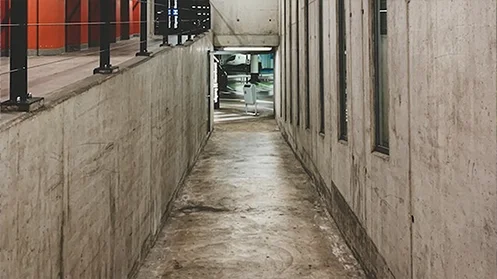
Loading Docks & Ramps
Concrete loading docks and approach ramps handle the hardest use case in commercial construction: constant heavy loads from forklifts and semi-trucks, chemical spills, impact from dock bumpers, and year-round exposure to Seattle's wet climate. Seattle Concrete builds new dock aprons, approach ramps, dock-high platforms, and truck court slabs for manufacturing, logistics, and warehousing facilities throughout King and Snohomish counties.
Design and structural requirements
Commercial loading dock slabs are typically 6–8 inches thick with #4 or #5 rebar on 12-inch centers, designed for Class C or Class D forklift loads and semi-truck rear axle loads (up to 34,000 lbs per axle for a standard 80,000-lb GVW truck). Dock aprons and the transition between dock height and grade see the highest stress concentration - we typically thicken these sections and add additional reinforcement. Mix design is 4,000–5,000 psi minimum with air entrainment for Seattle's wet conditions. Control joint placement is planned to direct cracking to joints, not random surface cracks.
New dock vs. dock repair
Existing dock aprons spall and crack from repeated truck impact and freeze-thaw cycling. If the damage is surface-level, a high-strength repair mortar or partial panel replacement is cost-effective. Full dock reconstruction makes sense when the slab has settled, rebar is corroding, or the dock height has changed due to building modifications. We assess and recommend honestly - we don't oversell replacement when repair is the right call.
Frequently asked questions
How much do concrete loading docks cost in Seattle?
Concrete loading dock costs in Seattle vary widely based on dock height, ramp length, slab thickness, and whether truck restraints or leveler pits are included. A basic new dock apron and approach ramp may start around $10,000–$25,000; full dock-high platforms with structural concrete walls run significantly higher. Every project requires a site visit and engineered drawings - contact us for a free on-site estimate.
How long does concrete loading dock construction take?
A new concrete loading dock in Seattle typically takes 2–4 weeks from mobilization to completion, including excavation, subbase preparation, forming, concrete placement, and cure time. Permit review and site conditions can extend the timeline. We sequence the work to minimize disruption to active warehouse operations where possible.
What permits are required for a loading dock in Seattle?
Commercial loading dock construction in Seattle requires a building permit from SDCI. Projects involving structural changes to an existing building or new approach ramps at the street may require additional review. We work with structural engineers and handle the permit coordination process for commercial clients.
How thick should a concrete loading dock slab be?
Commercial loading dock slabs are typically 6–8 inches thick with #4 or #5 rebar on 12-inch centers, designed for forklift and semi-truck loads. Dock aprons and approach ramps see the highest stress concentration and often require thicker sections or additional reinforcement. Mix design, compressive strength (typically 4,000–5,000 psi), and subbase preparation are all load-critical decisions.
How do I maintain a concrete loading dock?
Seal the dock surface every 2–4 years with a penetrating concrete sealer to resist oil, chemical spills, and moisture penetration. Fill joint cracks promptly with polyurethane caulk or epoxy to prevent spalling. Keep drain grates clear to prevent water pooling. Inspect the dock edge and approach ramp annually for cracking from truck impact - repair early to prevent progressive damage.
Service areas
We handle loading dock and ramp work across King, Snohomish, and Pierce counties, including in Kent, Auburn, Sumner, Tacoma, and Arlington. See all service areas.