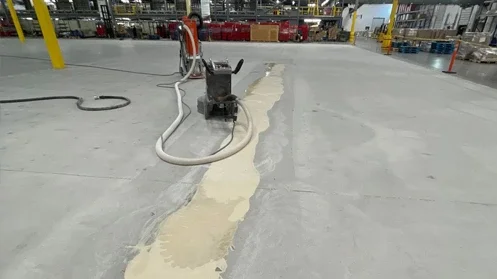
Concrete Grinding in Seattle
Concrete grinding takes material off the surface of a slab; it doesn't raise a sunken slab (that's slab lifting) or fill low spots (that's self-leveling underlayment). It uses rotating diamond-bond tools to remove the top layer, taking off coatings, adhesives, surface laitance, or high spots to create a flat, profiled surface. Seattle Concrete grinds for surface preparation, trip hazard removal, coating removal, and polished floor finishing across residential and commercial projects in King and Snohomish counties.
Free on-site estimate · Call (206) 552-9998 or request a quote
Surface profile and why it matters
The International Concrete Repair Institute (ICRI) defines nine Concrete Surface Profile (CSP) levels from CSP 1 (near-smooth) to CSP 9 (scarified/shotblasted). Grinding typically produces CSP 2–4. The target profile depends on what goes on top: self-leveling underlayment requires CSP 2–3, epoxy coatings require CSP 3–4, and decorative polishing uses successive passes from CSP 2 down to a near-mirror finish. We specify the target profile before any grinding begins so the result is correct for the application - not just "flat."
Grinding process
Grinding begins with a coarse-grit metal bond tool (40-grit) to remove surface material, followed by progressively finer tools (80-grit, 120-grit, and beyond for polishing). Most floors require a minimum of two passes for surface correction. We grind wet to suppress dust when working near HVAC intakes or occupied spaces, and dry with HEPA vacuum shrouds when wet methods aren't appropriate. After grinding, a liquid densifier is applied to harden the surface before sealing or polishing.
Common grinding applications
Surface prep for epoxy or polyurethane coatings, coating and paint removal, trip hazard removal at sidewalk panel joints, high-spot correction for flooring installation, and preparation for decorative overlays or staining. Grinding can also smooth trowel ridges on new slabs that cured with surface imperfections.
Surface prep for coatings and overlays
Most coating failures are prep failures. Epoxy, polyurethane and polyaspartic garage coatings, decorative overlays and stains all need a clean, open surface with the right profile, and grinding is the most controllable way to get it. Before grinding, the slab is checked for moisture and for contamination such as oil, curing compounds and old sealers that would block adhesion. Oil-soaked garage floors may need degreasing and extra passes. After grinding, cracks, spalls and joints are repaired so they don't telegraph through the coating. Acid etching is a cheaper alternative on some jobs, but it gives a less consistent profile and doesn't remove sealers or coatings; see acid etching vs. grinding for the trade-offs. For interior floors that need to be flat as well as clean, compare grinding with self-leveling underlayment; many floors get both, with interior floor leveling filling what grinding can't take down.
Trip-hazard grinding on walkways and sidewalks
When one panel of a walkway, patio or sidewalk sits a little higher than the next, grinding the raised edge into a smooth bevel removes the trip hazard without tearing out concrete. It's fast, quiet compared to demolition, and leaves the slab in service the same day. It works best on small offsets, roughly an inch or less, on panels that are otherwise sound. Bigger offsets, or panels that have sunk, call for slab lifting or replacement instead. On the public sidewalk in front of a Seattle property, any repair in the right-of-way goes through SDOT's permit process; see sidewalk repair and replacement.
Coating, adhesive and paint removal
Grinding strips old epoxy, paint, sealers, carpet glue, tile thinset and mastic so a new floor can go down. Thick or rubbery coatings may need special tooling that won't clog, and several passes. Older black cutback adhesive can contain asbestos, so it should be tested before any grinding or removal. Wet grinding or HEPA dust extraction keeps silica dust out of the air in occupied homes and commercial spaces. The ground surface is then ready for a new coating, a resurfacing overlay, or polishing.
Frequently asked questions
How much does concrete grinding cost in Seattle?
Concrete grinding in Seattle typically costs $1.50–$4 per square foot for basic surface prep or coating removal, and $4–$8/sq ft for a polished finish. Cost depends on slab condition, the number of passes required, and whether a densifier or sealer is applied afterward. Get a free on-site estimate before budgeting.
How long does concrete grinding take?
A standard residential or commercial concrete grinding project in Seattle takes 1–3 days depending on square footage and desired finish. Prep work - cleaning, crack patching, and masking - adds a few hours. Multiple grinding passes (coarse to fine grit) and chemical hardener application must be completed in sequence before a final polish or sealer.
Do I need a permit for concrete grinding in Seattle?
Concrete grinding of an existing slab - indoors or outdoors - does not require a permit in Seattle. It is a surface treatment, not a structural change. If the grinding is part of a broader renovation that requires a permit, those permit conditions govern the overall project.
What maintenance is needed after concrete grinding?
After grinding, apply a penetrating concrete densifier to harden the surface, then seal with a topical or penetrating sealer. Reseal every 2–4 years depending on traffic. For polished interiors, damp-mop regularly and re-polish every 3–5 years. Avoid acidic cleaners, which etch the surface and break down the sealer over time.
What types of concrete surfaces can be ground?
Concrete grinding works on garage floors, warehouse slabs, driveways, patios, sidewalks, and any flat concrete surface. It removes coatings, adhesives, paint, sealers, and surface laitance. It also levels high spots, removes trip hazards, and prepares surfaces for overlays, epoxy coatings, or decorative stains.
Can grinding remove a trip hazard on a sidewalk or walkway?
Yes, when the offset is small, roughly an inch or less, and the panels are otherwise intact. The raised edge is ground into a smooth bevel. Larger offsets or sunken panels need lifting or replacement, and repairs to a public sidewalk in Seattle need an SDOT permit.
Is grinding or self-leveling better for an uneven floor?
Grinding is better when the floor has high spots that need to come down. Self-leveling underlayment is better when low spots need to be filled or the whole floor needs to rise. Many interior floors use both: grind the humps, then pour underlayment over the low areas.
Service areas
We handle concrete grinding and polishing across King, Snohomish, Pierce, and Thurston counties, including in Kent, Auburn, Tacoma, and Marysville. See all service areas.