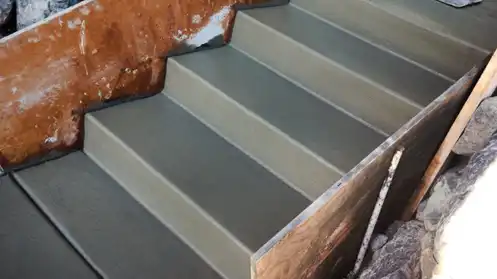
Concrete Steps and Stairs in Seattle
Concrete steps and entry stairs are among the highest-use surfaces on a property. In Seattle, where moss grows on anything that stays wet, concrete is typically the best long-term material for exterior stairs — properly designed and finished, it does not shift, rot, or deteriorate the way wood or composite materials do. We build poured-in-place stairs for entry landings, garden terraces, hillside access paths, and commercial access points.
Free on-site estimate · Call (206) 552-9998 or request a quote
Poured-in-place concrete steps
We form stairs directly on-site, fitting the exact entry configuration, grade change, and width your property requires. Rebar runs through every tread and riser — stairs carry concentrated foot traffic loads and need reinforcement proportional to that use. Forms are stripped after 24–48 hours; light foot traffic is safe at 72 hours; full cure is 28 days.
Seattle building code for exterior stairs
The International Residential Code (IRC R311.7.5), adopted in Seattle, sets maximum riser height at 7¾ inches and minimum tread depth at 11 inches. A handrail is required when there are four or more risers, or when the total vertical rise exceeds 30 inches. Steps in the public right-of-way require SDOT review; front-entry steps on private property almost never require a permit unless they connect to structural work on the house foundation.
Entry landings
Most stair projects include a landing at the top and at grade. Landings are poured monolithically with the stairs — one continuous pour is stronger than stairs attached to a separately poured landing. Minimum landing depth in the direction of travel is 36 inches; 48–60 inches is better practice at a main entry. All landings slope 2% away from the door threshold to direct water off the surface.
Finish options for Seattle stairs
Broom finish is the standard: a light texture dragged across the fresh surface creates consistent slip resistance and costs the least. Exposed aggregate is popular in shaded or tree-canopy areas because the stone texture grips well even when algae begins to form, and it looks intentional rather than weathered. Stamped finishes work well on large landings; risers and tread noses are broomed regardless for grip. For commercial applications we use troweled surfaces with applied non-slip strips.
Repair vs. replacement
Surface spalling on tread faces can be patched with a bonded overlay when the base slab is structurally sound. Cracked risers: hairline cracks are filled and sealed; if the riser has shifted, replacement is the right call. The most common repair situation in Seattle is settled stairs where the underlying soil has eroded — the steps drop away from the landing or list to one side. Cosmetic patching on settled stairs does not hold; the structure needs to come out, the subbase recompacted, and new stairs formed from a proper footing.
Frequently asked questions
How much do concrete steps cost in Seattle?
A typical 3–5 step front entry stair with landing runs $2,500–$5,500 depending on total slab area, rebar requirements, and finish. Larger terrace stairs or hillside access stairs are priced by scope at the on-site estimate.
Do I need a permit to replace front entry steps?
Usually not for like-for-like replacement on private property. If the stairs attach to a foundation wall, span a significant grade change, or the project includes structural work, a permit may be required. We confirm requirements before starting.
How long does it take to build concrete steps?
Forming and pouring typically takes 1–2 days. Steps are walkable after 72 hours. Full structural strength is reached at 28 days — avoid heavy loads or vehicle traffic before then.
Can concrete steps be built on a steep slope?
Yes. We form footings or grade beams down to stable bearing soil, then build the stairs up from there. Steep hillside access often includes intermediate landings every 10–12 vertical feet for code compliance and safety.
What is the best finish for concrete steps in Seattle?
Exposed aggregate or broom finish — both provide reliable traction when wet, which matters in Seattle nine months of the year. Stamped finishes are fine for landings with a non-slip sealer broadcast into the topcoat.
Service areas
We handle concrete stair builds and repairs across King, Snohomish, Pierce, and Thurston counties, including in Seattle neighborhoods, Edmonds, Mukilteo, and Shoreline. See all service areas.
Related Services
Related Articles